Life saving twin pregnancy case with classical homeopathy
A Twin Pregnancy, a Challenging Diagnosis, and a evidence based Homeopathic Case of Healing with Lab reports of Before, During & after treatment.
By Homoeopathic Dr. Sohail Ahmed·17 min read·
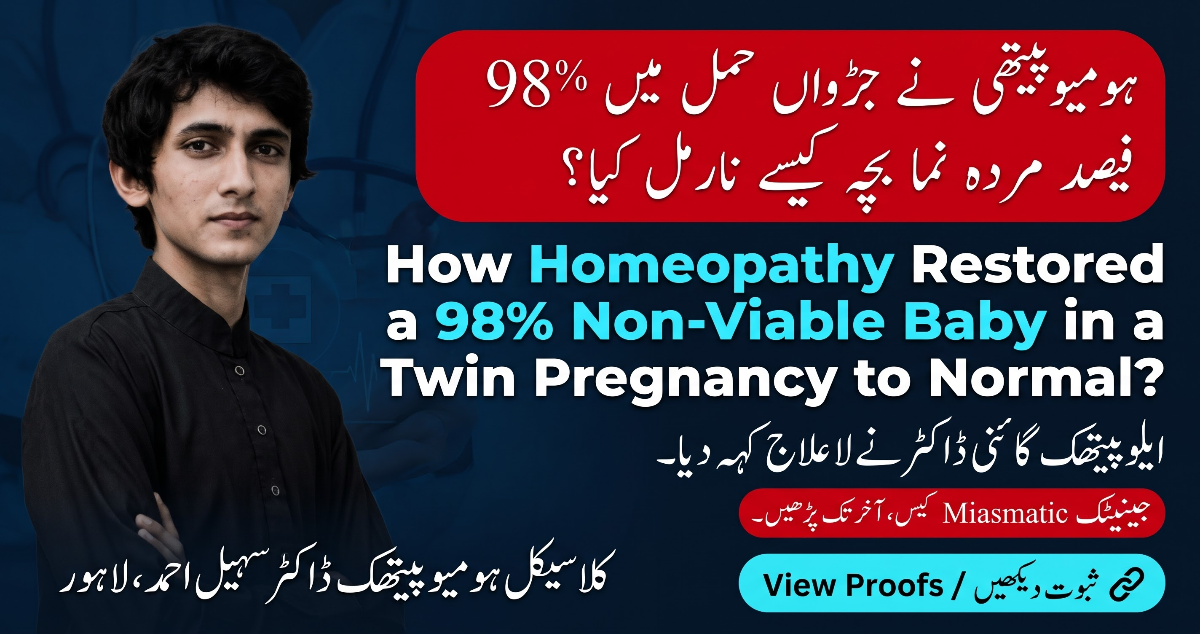
A Twin Pregnancy, a Challenging Diagnosis, and a Homeopathic Case of Healing
By Homeopathic Dr Sohail Ahmed | Classical Homeopath, Lahore
I am here to present a remarkable genetic-miasmatic case of healing, supported by scientific evidence, rational arguments, and logical reasoning. I will also present the relevant medical reports in accordance with both homeopathic philosophy and conventional medical requirements, including reports from before, during, and after the treatment, in the comments section.
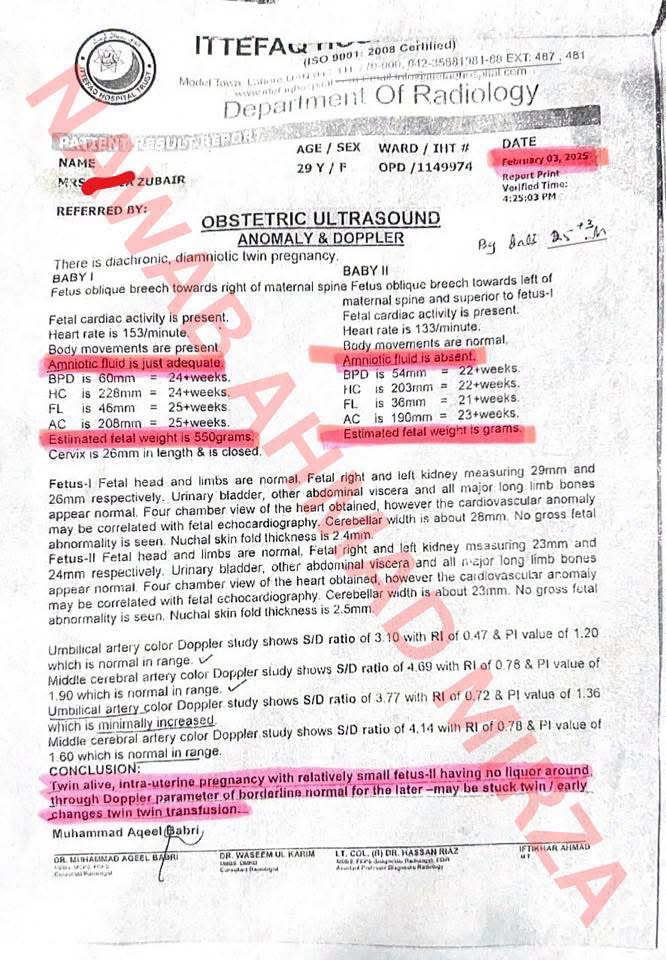
Before taking my Homeopathic treatment:
All I ask for is your prayers.
Dear readers, this woman had been declared a hopeless and untreatable case by an allopathic gynaecologist. It was her first pregnancy, and she was carrying twins. One baby was weak, while the condition of the second was so critical that its weight could not even be properly recorded. The second baby was considered virtually non-viable. However, in the absence of appropriate treatment, this condition could also have endangered Baby 1 and exposed the mother to severe complications and toxic infections. It could potentially have resulted in premature birth and an early surgical delivery.
Friends, some of our readers have repeatedly requested that I share the reports in chronological order, with their exact dates, in the comments section. So, this time, we have done exactly that.
You can visit the comments section and see how, by the grace and permission of Allah, the Creator and Master of everything, we achieved what I describe as the revival and normalisation of a baby who was almost 98% non-viable, while also doubling the health and growth of the other baby and protecting the mother.
Please stay with this article until the end, because things are going to become very interesting.
Thomas Kuhn and the Concept of Paradigms
Friends, Thomas Kuhn, a renowned philosopher of science and theorist, introduced the concept of the paradigm in his famous book, The Structure of Scientific Revolutions.
According to Kuhn, different scientific systems, such as allopathic medical science and homeopathic medical science, have their own fundamental assumptions, theories, philosophies, and terminology. Therefore, each system interprets things within its own theoretical framework.
For example, an allopathic doctor may prescribe Augmentin 1000 mg twice daily for a urinary tract infection. For the same patient, the doctor may also prescribe Sertraline or Fluoxetine for depression, Tramadol for migraine, and one or two supplements for nervous anxiety.
In contrast, a practitioner who follows homeopathic philosophy may prescribe just one medicine for all these complaints. That medicine could potentially be Staphysagria 1M, which, according to the homeopathic approach, may address the patient’s overall condition.
Moreover, a homeopathic doctor would never repeat a high-potency medicine in the same material manner as an allopathic doctor repeats a medicine such as Augmentin. A homeopathic dose might be repeated once every seven or ten days, rather than twice daily. Nor would the quantity of medicine be a whole basketful; it might consist of just two or three globules in a small vehicle, with two or three drops.
Friends, this is the difference between the philosophies and theoretical approaches of the two systems: one is based on material principles, while the other is based on dynamic principles.
Now, if a practitioner who follows allopathic principles attempts to evaluate or test homeopathic medical science entirely according to the standards of allopathic science, what will happen?
He may begin administering our homeopathic medicine according to his own philosophy and method. For instance, he might start giving Staphysagria 1M by the spoonful, three times a day, just like a syrup, with a full glass of water each time. He might insist that the patient must also take milk, prescribe ten additional medicines alongside Staphysagria merely in the name of suppressing the disease, and perhaps continue this practice for years.
Friends, am I wrong in describing this? Is this not how the two philosophies differ?
And what if a homeopathic doctor decides to test allopathic medical science according to his own philosophy? He might give a single Panadol tablet for ten different diseases and then wait for a week to see what happens, even if the patient deteriorates in the meantime.
Would that not be an irrational and unscientific approach? Of course, it would.
In other words, it is not scientifically sound to evaluate or experiment with another system by applying the principles, rules, and standards of one’s own system without considering the framework of the system being examined.
Let me give you another example.
Suppose a Pakistani citizen travels to Saudi Arabia and commits murder, or moves to London, opens a shop, and begins adulterating products and using dishonest weights and measures. If he assumes that he will be let off with a small payment, just as he might expect under the system he is familiar with in Pakistan, would that not be a misconception? Would he not be considered foolish for assuming that another country’s legal system operates according to the laws and practices of his own country?
Friends, this is simply a discussion about the philosophies, laws, and methods of two different systems. It does not mean that the medicines I have mentioned are the only medicines that may be prescribed.
In Kuhn’s framework, a scientific system cannot simply be made to operate according to another system, nor can it be interpreted entirely according to the latter’s preferences.
To investigate and evaluate homeopathy, one must first understand and consider homeopathic philosophy, its principles, and its laws.
In conventional medical research, medicines are tested on animals, whereas in homeopathic research, medicines are traditionally tested on healthy human beings. This is the distinction between the two approaches.
That is why a homeopath also asks about sensations and subjective experiences: after a proving, a human being can describe what they feel, whereas an animal can only demonstrate observable structural or physiological changes through its tissues.
In other words, when two systems of thought have different fundamental principles, definitions, and assumptions, it may not be entirely valid reasoning to reject or establish the claims of one system solely through the internal principles of the other.
Those who wish to challenge our claims should remember that, in order to understand a theoretical system and examine its internal claims, it is necessary first to understand that system within its own fundamental principles and framework.
Dear readers, this is not all. Imre Lakatos also discusses the philosophy of science along similar lines in his book The Methodology of Scientific Research Programmes.
Wait! There is more. Paul Feyerabend also discusses the philosophy of science in his book Against Method.
Now, let us move on to how allopathic medical science defines genetics and how homeopathic medical philosophy understands it. We shall also examine which of these approaches, through its claims, offers a solution to human suffering.
Genetic Manifestation: The Homeopathic and Allopathic Perspectives
According to homeopathic philosophy, it is understandable to describe a congenital abnormality present in the womb as a miasmatic or genetic manifestation. This interpretation can be understood within the philosophy of science.
However, according to conventional medical science, establishing a condition as genetic requires evidence of the transmission of genes from the parents. Merely identifying an abnormality at birth is not sufficient to establish that it is genetic.
Let me explain further.
According to homeopathic philosophy, when an abnormal condition or defect is already present in a child while still in the mother’s womb, and its presence is confirmed through modern diagnostic tests, it is not regarded merely as a disease that developed after birth. Rather, it is considered a congenital and hereditary condition.
Since homeopathy recognises hereditary influences, miasmatic tendencies, and constitutional weaknesses as factors that may be transmitted from one generation to another, such a condition is regarded, within the homeopathic framework, as a genetic case.
In other words, if a defect has already become part of the developing child’s constitution while still in the womb, and is present before birth, it represents a hereditary and miasmatic manifestation. In modern terminology, it may be described and understood as a genetic case.
Friends, these are two different theoretical perspectives, and this is one of the distinctions between the two systems of treatment.
Have the traditional rivals, India and Pakistan, ever fully accepted one another? Have Sunni and Wahhabi followers ever universally accepted one another as being right?
Friends, the human mind is often inclined to think in terms of its own interests. Sometimes it is one’s country, sometimes one’s identity, and sometimes one’s profession. People often find it difficult to accept a viewpoint that comes from the opposite side.
How Do Homeopathy and Allopathy Define Health and Disease?
According to homeopathic philosophy, health is a state of complete harmony between the body, mind, and spirit.
Whereas, according to the allopathic perspective, health is often assessed through the normality of laboratory reports, even if a patient remains so distressed by suffering and unpleasant sensations that they may eventually become suicidal.
This is precisely why a homeopath also asks about those sensations and experiences that cannot be detected through laboratory investigations.
😊
Now, let us examine how these two medical philosophies understand disease.
According to homeopathic principles and philosophy, disease is essentially a disturbance of the Vital Force, which is invisible, non-material, and dynamic in nature. This disturbance subsequently manifests itself in the form of symptoms.
Therefore, in homeopathy, symptoms are not considered the disease itself; rather, they are regarded as the expression of the underlying disease.
In contrast, from the conventional medical perspective, an abnormal laboratory finding is considered an important indicator of disease, whereas homeopathy regards laboratory reports as clues that help identify the location and severity of a condition.
Let me explain this with an example.
A patient may undergo an enormous number of laboratory investigations on the advice of an allopathic doctor. After all these tests, the reports may turn out to be completely normal.
Since the conventional practitioner may have already tried various medicines without obtaining a satisfactory result, the patient may eventually be told:
“There is nothing wrong with you. You are perfectly fine. You can go now.”
Friends, I would sacrifice everything for the great Hahnemann, who taught that health is a state of complete harmony between the body, mind, and spirit. ❤️
At this point, a homeopathic practitioner may still recognise the person as a patient and offer support. He may ask about the patient’s deepest feelings, desires, fears, dreams, and emotional experiences, even when these cannot be detected through laboratory investigations. He also attempts to address these experiences.
As evidence of the results of my work, I have countless Google reviews and video feedback testimonials.
Now, if these feelings, desires, and emotional experiences become normal and pleasant, what laboratory report could an allopathic doctor possibly ask for to measure that improvement? 😃
Friends, when a homeopathic doctor, by the will of Allah, successfully treats a chronic or genetic condition, conventional practitioners often demand laboratory reports. They do not readily accept signs and symptoms as sufficient evidence.
Yet, when patients with epilepsy, OCD, migraine, or schizophrenia come to them, they also have to rely on signs and symptoms.
They even advertise themselves on their clinic boards as specialists in treating various diseases. Why do they not simply write that they are specialists in providing temporary support or first aid? Why not mention that, alongside managing one disease, patients may receive five additional diseases as a free gift?
Friends, you may criticise me because of professional bias, but you cannot refute my arguments merely through prejudice. You must address the logic and reasoning behind what I am saying.
Dear readers, the words of a Hadith found in Sahih al-Bukhari and Sahih Muslim state:
“Beware! There is a piece of flesh in the body. If it is sound, the entire body is sound; and if it is corrupt, the entire body is corrupt. Indeed, it is the heart.”
Friends, do you now understand why homeopathy is described as a holistic science?
Imagine a patient telling an allopathic doctor:
“Doctor, all five of the tests you ordered are normal, but I am still not well. My heart feels restless, I have no mental peace, and my entire body remains exhausted.”
What would the allopathic doctor do?
He might prescribe sleeping medication, antidepressants, painkillers, or perhaps some supplements.
But has he not contradicted his own approach? The disease has not even been diagnosed yet. So why prescribe medicines?
If prescribing medicines indefinitely, even when a disease has not been established through diagnostic investigations, is considered acceptable, then why should laboratory confirmation be an absolute requirement when a homeopathic doctor claims to have resolved a genetic condition?
After all, the patient’s symptoms and all the complaints they originally presented with have disappeared. So why insist on laboratory reports?
A Question for Allopathic Practitioners
When an allopathic practitioner can identify and presume the presence of a disease on the basis of signs and symptoms, even without laboratory confirmation, and then decide to prescribe medicines, why must a homeopathic practitioner’s claim of healing necessarily be established through laboratory tests?
If an allopathic practitioner can identify a disease through signs and symptoms, why should a homeopath not be allowed to declare improvement or recovery when those very signs and symptoms have disappeared?
I can show you countless MRI and CT scan reports in which no specific abnormality has been identified, yet the patients have been suffering from epileptic seizures for twenty years or more and have been taking sedating medications.
Friends, is this not a complicated state of affairs? 😃
Dear readers, show me any CT scan or MRI in the world that can diagnose epilepsy itself or identify its underlying cause in every case.
And show me an allopathic doctor anywhere in the world who has successfully cured epilepsy.
When conventional practitioners can rely on a patient’s signs and symptoms to diagnose epilepsy and prescribe drugs such as Lyrica and Epival, why should a homeopathic doctor be required to produce an MRI or CT scan as proof of recovery?
Is this not a contradiction?
Do the patient’s feelings and suffering have no value, even though up to 70% of these experiences may not appear in laboratory reports?
If a particular test cannot establish the diagnosis of a disease, how can that same test, by itself, confirm that the disease has been cured?
Is this not another contradiction? 😁
The Case: A High-Risk Twin Pregnancy
Now, let us come to the actual case.
My patient had returned to Pakistan from China. It was her first pregnancy, and she was emotionally devastated by the situation. She was in the twenty-fifth week of pregnancy, with the third trimester approaching, and was carrying twins.
According to the obstetric ultrasound performed on 3 February, Baby 1 was weak but functionally normal. The estimated fetal weight was 550 grams, and the amniotic fluid level was normal.
However, Baby 2 was in an extremely critical condition. Its weight was not even measurable, and the amniotic fluid was completely absent.
Friends, this condition is referred to in modern medical terminology as TTTS (Twin-to-Twin Transfusion Syndrome). In this condition, one twin may die while the other may suffer neurological complications because both babies share a single placenta with connecting blood vessels. The mother may also face serious complications. In certain cases, there is a risk of losing both babies.
When we investigated the patient’s history further, we learned that she had been living in a coastal area of China, close to the seashore.
Friends, people living near the sea have to survive in a humid, salty-air environment. This may be associated with various forms of dryness in the body and conditions related to dryness, a phenomenon described in homeopathy as Aggravation by Seashore.
In this particular state of dryness, the body’s water balance becomes disturbed. An imbalance in osmotic pressure may occur, resulting in a deficiency of water in certain areas and an excess of water in others.
In other words, because of the uneven distribution of water within the human body, fluid may begin accumulating in the interstitial tissues instead of remaining appropriately distributed within the blood and cells.
Consequently, electrolyte regulation may also be affected. For this reason, the normal supply of nutrients and minerals from the mother’s body to the babies may become inadequate during pregnancy.
This may also explain why swelling develops in the feet or arms during pregnancy. Fluid containing salts accumulates in the interstitial tissues, while the pregnancy itself becomes deprived of adequate fluid supply or its normal availability is lost.
In this way, TTTS develops.
For this particular chemical disturbance and the specific pattern of causation, there is a remarkable medicine in homeopathy: Natrum Muriaticum.
The typical Natrum Muriaticum patient is considered intensely introverted and tends to keep everything inside.
This may include suppressed thoughts, which can lead to migraine; suppressed bowel urges, which may result in constipation; and old grief or the profound sorrow of separation from a loved one, which may be associated with fluttering sensations and palpitations.
Natrum Muriaticum is regarded as a leading remedy for women who remain emotionally attached to the past and live with regrets.
Once we have identified the chemistry and causation, even if a thousand different conditions or diseases are presented, the indicated remedy, according to this approach, remains the same.
My respected readers, Natrum Muriaticum is one of those major remedies whose successful use can contribute greatly to a homeopathic doctor’s reputation.
The patient was given repeated weekly doses of Natrum Muriaticum, along with only Aletris farinosa.
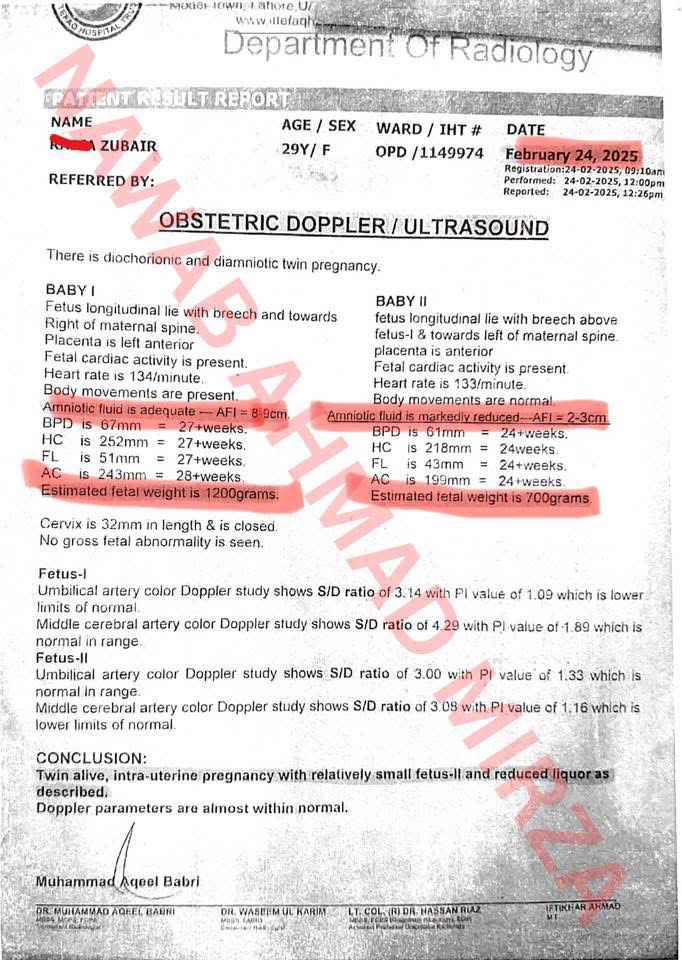
By the grace of Allah, the growth and development that had not occurred over the previous 24 weeks took place within just 20 days.
Baby 1’s weight increased from 550 grams to 1,200 grams, more than doubling.
And Baby 2, which had appeared almost lifeless and whose weight had been recorded as zero, increased to 700 grams.
The amniotic fluid also began to develop, whereas it had previously been completely absent.
Alhamdulillah!
During treatment:
But that is not all!
Wait, let me also show you the follow-up from the third visit, which took place another 26 days later.
Dear readers, during this visit, an obstetric colour Doppler ultrasound was performed on 20 March.
Baby 1, whose weight had initially been 550 grams, had first increased to 1,200 grams and then, over the following 20 days, increased by another 50%, reaching 1,745 grams.
And Baby 2, which had initially been recorded at zero and subsequently increased to 700 grams, had now reached 907 grams.
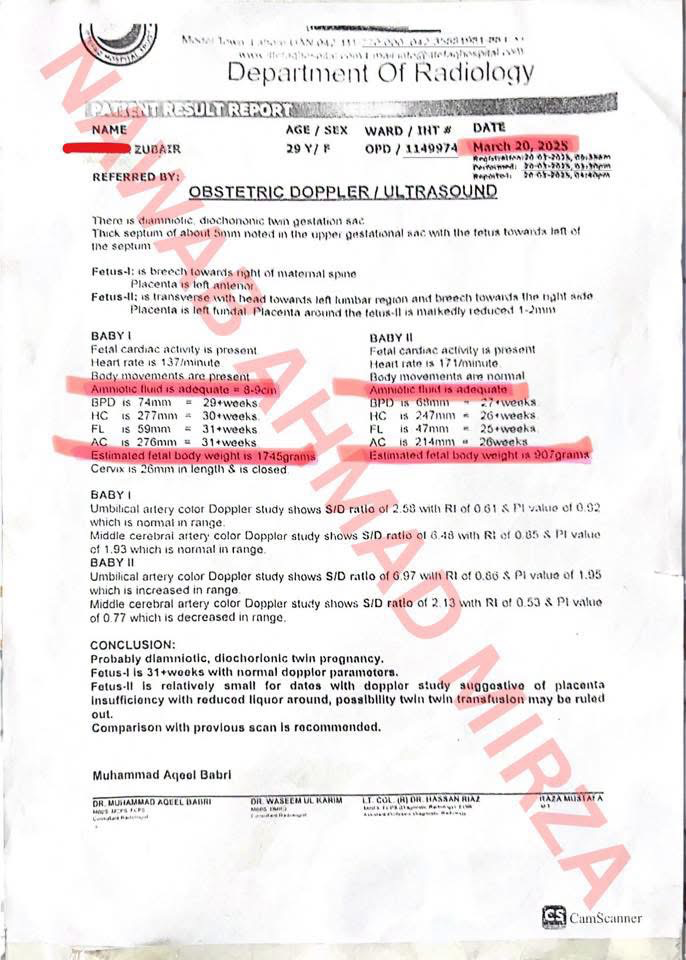
Alhamdulillah, by the mercy of Allah, the amniotic fluid had also become adequate and normal. ❤️
Friends, would you like to know something interesting?
All three ultrasound examinations were performed by the same gynaecologist at Ittefaq Hospital, Model Town, Lahore — the very same gynaecologist who had previously declared that there was no solution to this case.
And those who start prescribing medicines for a fever and continue giving medicines until the patient reaches the grave tell us that we cannot treat genetic conditions and cannot provide evidence of our results!
My respected followers and readers, I have just one request:
Please mention or tag all those people in this article, and share it widely so that people throughout the world may become aware of these facts.
And if you are reading this article in a Facebook group and cannot find the supporting evidence in the comments section, please visit my personal Facebook profile and open this very article directly. You will find the evidence, complete with dates and references, showing the reports from before treatment, during treatment, and after the claimed recovery.
Please do not forget to follow my account.
If you wish to appreciate my hard work, share this article without prejudice or professional bias.
May Allah reward you abundantly for your sincere intentions, and may He remain my Supporter and Protector.
Written, researched & cured by:
Homeopath Dr Sohail Ahmed
Classical Homeopathic Doctor
Lahore, Pakistan
- #Twin pregnancy
- #High risk pregnancy
- #amniotic fluid
- #genetic diseases
- #allopathy
- #homeopathy